
The Love Patent Letter, Adapted for you!


709320934_158
Dear You,

I would like to tell you a true story that revolutionized my understanding of God, the “good news,” and my relationships.  In fact it has been so life-changing, that I felt the Lord command me not to speak anywhere new, that I do not share this story!

Simply put, there is nothing I deem more important than this message in order to have intimate, and yes, unshakeable relationships that come from God Himself.

In 1987 I was in a patent office in Düsseldorf Germany for a fairly important business meeting.  My German at the time was weak, which was all for the good because I was in a rather desperate place. Up to this particular day I had walked with the Lord for about 15 years, and had gained a greater understanding of God’s love.  But I was still struggling in many areas.  I had heard a gospel that basically said, “Jesus laid His life down for His friends,” but frankly this wasn’t doing me much good.  Not for the state of turmoil I was in.  I was feeling like my expectations had become my greatest enemy, and every time they weren’t lived up to I became part of the problem.

As I sat there in this patent office, a certain verse out of the Bible kept cycling through my consciousness, “Perfect love casts out fear.” ¹ When I finally became aware of it (you know, kind of like the moment you finally become conscious of a melody which was continually playing in your mind), my awareness took the form of, “That’s interesting – love casts out fear.”  But suddenly I felt inwardly rebuked, “NO! Love creates fear. Perfect love casts out fear!”

It then came to be that “perfect” love was explained to me, right there, in the parable of a patent. Now I don’t know if you know anything about patent law, but in general a couple of things are required to get a patent on a new idea, device, or process. The first thing is to describe what is called, “the state of the art.”  This is the prior art of something, or that which is already known about it. This makes the existence of something “as good as it gets,” or perhaps more accurately, “as good as it has gotten.”  Next, comes a description of what the patent applicant thinks he has that’s new, something never done or practiced before. This is called the “abstract”. Finally the clincher is the reduction to practice, or the “demonstration” of what is new.

Now there’s more, but at this point my mind was racing!  I had to ask for a pen so I could write as fast as I could.  What I was understanding was that previous to the Cross there was a “state of the art” love that was understood, and like patent law, was “as good as it gets.”  Jesus described it as, “Greater love hath no man than this, that a man lay down his life for his friends.” ²    Paul too spoke of it, saying, “For scarcely for a righteous man will one die: yet peradventure for a good man (i.e. for a friend) some would even dare to die.” ³

But then I was reminded of the whole of Paul’s message.  “For scarcely for a righteous man will one die: yet peradventure for a good man some would even dare to die. But God commendeth (demonstrated) His love toward us, in that, while we were yet sinners, Christ died for us.”, and again, “if, when we were enemies, we were reconciled to God by the death of his Son, much more, being reconciled, we shall be saved by His life.”

I was blown away.  Jesus is God’s love patent, and He demonstrated a love that was previously not known until He came and died for His enemies.  This means I was qualified! I was qualified not because I “deserved” His love.  Jesus gave Himself to me on my most ignorant, weakest and sinful worst day.  He extended love and forgiveness to me when I was the one putting Him on the cross!

Suddenly the gospel – and it’s relational implications – was opened up to me in a whole new way.

Now I had never seen anything like this before, and I had to ask the question, “How is that possible????” Then I heard His voice again, “The day I said I love you, I nailed my expectations to the tree.”  My mind was still racing. This time it came to rest at another passage from the Bible, “And you, being dead in your sins, and the uncircumcision of your flesh, hath he quickened together with him, having forgiven you all trespasses; Blotting out the handwriting of ordinances that was against us, which was contrary to us, and took it out of the way, nailing it to his cross;” (4)

In that patent office, Jesus finally went on to say, “… And if you are going to love like I love, you too are going to have to nail your expectations to the tree.”

A Redemptive Love, not a Reactive love

From what you have written, my friend, I’m guessing that you have mostly seen, and have been on the receiving end of the kind of love that’s only good for friends.  Sadly what has been calling itself “church” is full of it. It is the kind of love that is based on – even reactive to – the perceived value of its object.  But as demonstrated by Jesus, there is another kind of love, and it is based on the value of God: “Hereby perceive we the love of God, because he laid down his life for us: and we ought to lay down our lives for the brethren.” – “This is how we know what love is, Jesus Christ laid down His life for us, and we ought to lay down our lives for each other.” (5)

Now obviously it gets really tricky when we have to love others on our worst days, especially the worst days of those we claim to love.  It’s those days that no one really feels like they deserve love, or are able to give it.  But for me this has become the most important understanding of taking up my cross daily.  Because of what He did for me, I don’t have to be alienated from those I disagree with.  His love empowers me to be lovingly redemptive toward them.  It is capable of loving those who are bad, and making them good if they can believe it.  And it is capable of opening up door to walk in true intimacy with them.

Are we up for it?  Without this kind of love my friend, the family of God is bankrupt.

Love!
Jay Ferris

(1) 1 John 4:18  (2) John 13:38  (3) Romans 5:7  (4) Col. 2:14  (5) 1 John 3:16
Posted in J.Ferris: Reposts with Notes, J.Ferris: Top Posts | 1 Comment

The Unlimited Liability of Jesus’ Home

rsz_prcas2617
Where the “cost” of following Jesus is concerned, you may remember He once said to a young man who wanted to follow Him, “Foxes have holes and birds of the air have nests, but the Son of Man has no place to lay his head.”(1)

Surely, having no place to live is a great cost, so great that most of us can dismiss the idea as not having relevance for us today. In seeming contrast to this verse, however, how many of us noticed that Jesus DID have a home?

“… Jesus … went and lived in Capernaum…”(2)

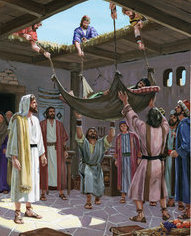
“When Jesus again entered Capernaum, the people heard that he had come home. So many gathered that there was no room left, not even outside the door, and he preached the word to them. Some men came, bringing to him a paralytic, carried by four of them. Since they could not get him to Jesus because of the crowd, they made an opening in the roof above Jesus and, after digging through it, lowered the mat the paralyzed man was lying on. When Jesus saw their faith, he said to the paralytic, “Son, your sins are forgiven.” (3)

“… They came to Capernaum. When he was in the house…” (4)

Whether or not Jesus or His family owned the house, rented the house, or were more or less extended house guests, it is clear that there was a place in Capernaum called “home”, and it apparently included a house.

Now before Jesus went to this location, however, He was in next door Nazareth where He was raised. It was here that He announced His anointed purpose in the local synagogue.

“He went to Nazareth, where he had been brought up … ”The Spirit of the Lord is on me, because he has anointed me to preach good news to the poor. He has sent me to proclaim freedom for the prisoners and recovery of sight for the blind, to release the oppressed, to proclaim the year of the Lord’s favor.” (5)

It was after this that Jesus went to the next town, even to the house where He was then living.  And it was here that the man was lowered through the roof.

Broken People Break Things

Obviously Jesus’ agenda of bringing the good news and setting people free was one that He not intend to accomplish in an institutional context. His lifestyle, and that of the early Church gave evidence that it was not His heart to institutionalize people, but to meet them in their brokenness and transform their lives in a vital community of faith. He brought His work home with Him, one consequence of which was that the roof was torn off of the house where He was staying.

Institutional ministry by its very nature is limited liability ministry. The ministry of Jesus was unlimited liability. Where having a place is concerned, an unlimited liability mindset is one which does not claim even bird’s nests or fox holes. It is capable of occupation without possession or grasping.

Our point for present purposes is that having a home does not disqualify us from following Jesus. The important thing is our attitude about the things we possess, even the place where we live. If our homes are not going to be off limits to the agenda of Jesus, then we must face up to the cost. Jesus wants to accomplish His purpose from house to house. This means opening our homes, our families, and our lives, to poor, broken and oppressed people, and broken people break things. In their desperation they, and/or their friends have even been known to tear the roof off.

Are we ready for this? Are we ready for unlimited liability? Or would we prefer to go on touching lives at the relatively safe distance of our institutional programs, churches, and buildings?  I need to confess that I do not lose much sleep contrasting my own ministry to that others, that of Mother Teresa, for instance. My problems of conscience come from what I am doing or not doing in my own home.

Having flirted with His purpose in the past, it is clear that isolated individuals and families are quickly overwhelmed by the enormity of the task and the world’s response to even limited success.   As a result there are more broken people than occasional even semi-sold-out saints can handle. Making the effort, one quickly discovers why, in so many cases, those who take The Lord seriously do so by appointment, some place else, and for earthly compensation.

It is still my hope that a vital community of faith could both risk, and actually walk in the heart of Jesus.

Isn’t it time for the nets, torn by our institutions, to be mended, and the limits of liability be removed from the Church? Isn’t it time for “church” to cease being something that we do some place else?

  1. MAT 8:19,20, 2. MAT 4:12,13, 3. MAR 2:1-5, 4. MAR 9:33, 5. LUK 4:16-24

Jay Ferris,  2/14/91

Posted in J.Ferris: New Releases, Jay Ferris Writings | 4 Comments

Behind the Scene “Battle Plan” Letter

.
Dear ________,
tower-babel .
Recently I was impressed with a question:
 .
What does it mean that is written,
“And it was given unto him to make war with the saints, and to overcome
them”
? Revelation 13:7
 .
That was the question, and the following passages came to mind as I
wrestled with God for an answer:
.
“And they said, Go to, let us build us a city and a tower, whose top may
reach unto heaven; and let us make us a name, lest we be scattered
abroad upon the face of the whole earth.” 
Genesis 11:4
.
“Those people are zealous to win you over, but for no good. What they
want is to alienate you [from us], so that you may be zealous for them.”

Galatians 4:17
 .
Here the beast, (man as Satan’s agent) was given power to make war against the saints, and to overcome them.  How can this be, since the saints are “more than conquerors” in Christ?  Surely the “new man” cannot be defeated by the beast.  It must, therefore be the “old man.”  The “new man” reigns with Christ, but to do so, he must first be “beheaded.”  How can Christ be our head, if we still have our old one?  So Satan is in the business of beheading the “old man.”  As it was with Christ, so it is with us, if he had known the result, “he never would have crucified the Lord of Glory.”  The beast can only do what Satan empowers him to do, and he only says what Satan says…This war against the saints is Satan’s idea. Whose idea was it to build the tower of Babel? It was Satan’s idea.  They did it because they thought that they would be scattered if they didn’t have a name and a building. It was a variation on the same lie that the serpent told the woman in the Garden.
 .
It was the wrong name and the wrong building. It has something to do with builders. It does not say, “the stone that some of the builders rejected…” Jesus is the stone that all of the builders reject, because it is either His building or theirs. He is the only one who can build His building.  All man can do is submit as building material or mess it up when we try to help. As soon as we build anything, we have something to lose, and so are compromise.
 .
The war against the saints is a war against God’s building. God builds with living stones, and He builds by placing them in right relationship with one another. It is right relationship under God that is the focus of the beast’s attack or warfare against us. “And because iniquity abounds, the love of most will grow cold.”  It is the Love of Christ that binds us together in right relationship. Iniquity is a weapon against love.
 .
If we claim to be lovers but have not love, we are dead meat or if the love that we have is not God’s kind of love, i.e. the love that was redefined at the cross, then our love cannot overcome iniquity. The “old man” is incapable of God’s kind of love. Only the “new man” of Christ in us is capable of a love that is more than a conqueror in the face of iniquity. It can only be that the beast has the power to make war against the saints to overcome them because the saints are trying to muddle through with the wrong kind of love. We must be beheaded of that muddle-headed kind of love, and the beast, inspired and energized by Satan, is God’s instrument for the completion of that task. It is the task of the cross, and He who began this work in us, to finish it in us.
 .
Relationships that come from God are the enemy of Satan, and the builders are his agents against such relationships. They make war against relationships that come from God. You have heard that the beast is coming, even now many beasts have come. What else could Paul be talking about, that he “fought wild beasts at Ephesus”? 1 Corinthians 15:32
 .
If our being one, “as Jesus and The Father are one,” is the way He has chosen and prayed “that the world may know..,”, then our loving one another in that oneness is the greatest possible threat to Satan.  It is no wonder that the builders do everything possible to alienate us from Christ in each other,  They want us to be zealous for them and their buildings.
 .
In my experience, the war is horrendous.
 .
Yours in Christ,
Jay
 .
P.S. “The Wild Beasts of Ephesus” … That is where they tested them that say they are apostles, wasn’t it?? :-)
.
Posted in J.Ferris: New Releases, J.Ferris: Warfare against Intimacy and Conversation | 4 Comments