The Earnest of Being Important


The other day I was reminded of the following sent to a pastor friend of mine some years ago now:

Subject line: “Shakespeare – Wilde”

“Dear Terry,

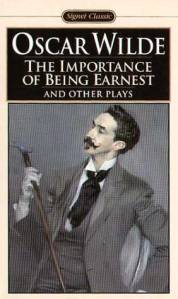
After our conversation yesterday, as well as catching up on my reading at your suggestion, I had two rather famous titles come to mind this morning; “Much Ado About Nothing,” and “The Importance of Being Earnest.” This last booted up in my brain as “The Earnest of Being Important,” (Oscar Wilde). It seemed to me like it should have been a Shakespearean title.

In any case with that bizarre intro, let me get quickly to the point.

(By the way it is all right if I call you Terry, isn’t it? I could have addressed you as “Brother Terry,” but I have a brother in the flesh, and I never called him, “Brother Ned,” because he really was my brother. Since you really are my brother, I thought I would just praise the Lord, and call you Terry. Come to think of it, under the leading of the Spirit, I even get to call my heavenly Father, “Daddy.” Somehow that doesn’t seem to have the proper dignity to it, at least, not by the standards of this world.)

First, I need to get some chips on the table:

Galatians 2:6 “As for those who seemed to be IMPORTANT–whatever they were makes no difference to me;”

Mark 9:35 “And he sat down, and called the twelve, and saith unto them, If any man desire to be first, the same shall be last of all, and servant of all.”

Mark 10:31 “But many that are first shall be last; and the last first.”

Matthew 23:5-12: “But all their works they do for to be seen of men: they make broad their phylacteries, and enlarge the borders of their garments, And love the uppermost rooms at feasts, and the chief seats in the synagogues, And greetings in the markets, and to be called of men, Rabbi, Rabbi. But be not ye called Rabbi: for one is your Master, even Christ; and all ye are brethren. And call no man your father upon the earth: for one is your Father, which is in heaven. Neither be ye called masters: for one is your Master, even Christ. But he that is greatest among you shall be your servant. And whosoever shall exalt himself shall be abased; and he that shall humble himself shall be exalted.”

Matthew 18:4-6: “Whosoever therefore shall humble himself as this little child, the same is greatest in the kingdom of heaven. And whoso shall receive one such little child in my name receiveth me.  But whoso shall offend one of these little ones which believe in me, it were better for him that a millstone were hanged about his neck, and that he were drowned in the depth of the sea.”

Perhaps that’s enough to get started with. What really came clear to me this morning was the apparently very carnal tendency that we all have to interact with people in their order of importance. The “platform” people, of course, get our greatest respect and attention. We are most careful with the dignity of those of greatest title. We are not so careful with the average pew sitter, and the “little ones” get our least attention. Jack Frost has correctly pointed out that, “to be humble before God is not to be very humble at all, for God is in a very high place. But, to be humble before a child, is to have the kind of humility that Jesus is looking for.”

Jesus places great importance on not offending the little ones. Offending “little ones” seems to be a capital crime in The Mind of Christ. The implication of the passage seems to be that offending the “big ones” is, either not as big a crime, or less likely to happen, so doesn’t need the capital punishment deterrent. I found myself asking myself, “Why is that?” What is it in us that might be more inclined to offend or be indifferent to offending a “little one” than a “big one?”

Could it be our own desire for position? Do we go and make things right with a platform person or, higher still, the one who determines who gets to be on the platform, because we are striving to be there ourselves? But making things right with a child isn’t seen as important because they are not important? When the “little ones” are still in the womb, they are regarded as of so little importance, that they are discarded altogether.

What I have seen is that going to those whom we have offended is not the number one favorite thing to do in the Kingdom of God in any case, but we are much less likely to go to the “little ones” we have offended than the “big ones.” Yet, a little one who is offended can be much more deeply scarred, and that, for a lifetime. The “big ones” are a little thicker skinned, and not so deeply wounded by a careless word or a lapse of love or faithfulness. If an “orphan spirit” is something that happens to most of us at an early age, and that because we have been stumbled by an authority figure in our life. And, if an “orphan spirit” is the very opposite of the “spirit of sonship” that God wants to impart to us by the perfected work of His own Son, then offending “little ones” is, in deed, a much greater offense than offending “big ones.”

So much for the theory, now to the practical: Over the years, as my wife Carleen and I have ministered to others and taken them into our hearts, home, and family, there have been many occasions when people have simply walked away for whatever reason. For the most part, these relationships have since been reconciled and put right. People came back and apologies were made and received … to Carleen and me, that is. But I have only recently become aware of how deeply offended our children were in all of this, and when people came back our children were not seen as being of sufficient importance to get apologies of their own.

Funny thing happens though – children have a way of growing up and becoming important in their own right, important, but damaged–damaged by the lack of real humility among the saints. Again, I have to ask myself, Is “spiritual abortion” any better than physical abortion? Do you think we will ever get the “platform mentality” out of our heads, and replace it with the mind, and humility of a little child?

It’s easy to talk humble when you are on the platform, not so easy to be humble when you are striving to get there. I guess the proof is in the striving. “…But Seek ye first the Kingdom of God and His righteousness, and all these things will be added unto you.”

Yours in Christ,

Jay

P.S. Please feel free to use any of this that might be helpful anywhere you think it might be needed. 1 Peter 5:1-10″

Love!

  • By Jay Ferris, originally posted August 2012
Posted in J.Ferris: Reposts with Notes, J.Ferris: Warfare against Intimacy and Conversation | Leave a comment

Parable of the Fig Tree *Audio

As I was foraging around in my files, I came across this sound bite from some sharing that I did a number of years ago back up in the Connecticut Shoreline. I haven’t yet succeeded in finding the rest of the message from that day, but thought perhaps this stands well enough on its own to post it here. It puts Jesus back in the center of human history where He has been, and still belongs.

To listen to this short audio, Click Here

Love!

  • By Jay Ferris, originally published August 2012.
Posted in J.Ferris: Reposts with Notes | 2 Comments

Shacking Up

Shacking Up
This past weekend during a time of rich fellowship and conversation, we touched on the best selling book, “The Shack.” When asked my opinion I sent the author a qualified rave review:

“Dear Paul,

… It came to me to speak about the Word and the Spirit in terms of the “lyrics and the music.”

Go ahead and ask me if I’m not just a little bit envious that you write such beautiful music while I seem only gifted to slog along a little closer to the earth, just doing the words, in fact, more often than not just trying to “do the math.” That said, there is something to be said for a good lyric, and perhaps, together we might be able to collaborate on a beautiful love song or two.

Sometimes it’s not so easy to distinguish or separate the words from the music. Jesus said that “… the words I have spoken to you are spirit, and they are life.” John 6:63

If the content of those words was spirit when Jesus spoke them, then I’m inclined to treat them as such, even in the written form by which they have been passed along to us. In other words, I believe that it is important to continue to get what Jesus said, and is saying now, in the Spirit, whether in written form or spoken by The Spirit to our hearts.

I really appreciate your stronghold pulling down, and imagination smashing paradigms – certainly very needed, if we are going to move from being terminally religious to eternally, and divinely relational. :-)

I also appreciate your willingness to use lingo, seemingly calculated to win the new age “lost,” even at the expense of offending the allegedly “Christian saved!” :-)

I find your portrayal, and even defense of the Trinity a wonderful contrast to your willingness to blow so much crippling theology to hell.

I guess you know that there is pretty near as much controversy over the Trinity as there is over “UR.” (Ultimate Reconciliation)

Before getting deeper into the lyrics and the music, just a few thoughts concerning the present anti-Bible environment. I believe the root cause is what has been calling itself “church,” and what has been calling itself “Christianity.” As you know, I don’t believe that there is anything wrong with either of those words, “Church” or “Christianity.” The problem is with who is doing the calling. When we are doing the calling, it’s primarily out of desire for reputation. That is not Christ – that is anti-christ. I believe, everything else being equal, this applies to most all the stuff; “ministries,” “churches,” “dotcoms,” “cyber-cathedrals, “networks,” “organizations,” “programs,” “coping mechanisms,” (I was very happy to see you identify these by that description in you book) “positions,” “offices,” “titles,” etc.

The problem is that Jesus, and The Bible have been, and are increasingly tarred with the same offended brush as what’s calling itself “church!” The war against the Bible right about now is probably proactively, intentionally, and maliciously worse than anything that has been seen since the canon of the Scripture was settled early on. That’s why I feel the need to say a word on behalf of the Lyrics. The Lyrics are part of the love song, and it is not for human instruments, intent on leading disciples away after themselves, to change the words of the song. (I hope you know that I am not referring to you here.)

As for me, the veracity of the Scriptures was settled early on in my own experience of The Lord. I am making no claims for any particular translation here, only for what was originally written and compiled in, and by The Spirit. Where detractors point out “contradictions,” I see only the result of my own lack of understanding or revelation. I have come to see the apparent contradictions as divinely inspired incentives to press us further into Christ for the answers. In short, it’s for the Holy Spirit to make the obscure or seemingly contradictory clear, not for men to manhandle the Lyrics. Religious experts have a way of turning the Lyrics that God wrote into a discordant cacophony resulting in division among the music lovers. It has been this way right from the beginning, at least, since the apostle Paul began to warn the elders at Ephesus about it.

So here is my concern with your wonderfully creative liberty in writing the music of The Shack. Clearly what you have written is being used or taken as encouragement by the Biblical detractors, for their further distortions of the Word of God – distortions that, in effect, even if not by design, gather followings to and for the benefit of the religiously ambitious at the expense of the cause of Christ.

You clearly have a number of agendas in writing your book. As far as I can tell they may certainly be Spirit led agendas. God knows it’s past time for “liberty to be proclaimed throughout the land” once again.:-)

What I would like to do is share a few elaborations or etudes connected to your greater symphonic movement that may help with some needed damage control.

I guess you know that the symphony of God’s communication with us is rather large and complex, no matter how we look or listen at it. Like any symphony, it is diminished when instruments or portions are left out. Now, I realize that in a finite amount of time and space it is not possible to cover it all, but care needs to be taken that what we do play is not heard in such a way as to give misleading impressions about instruments or portions that are not played.

I understand, for instance, that The Shack is not about “UR” but it seems to have had the effect of creating a “UR” impression in the minds of many. If I am correct in my understanding that you are or have been a “UR” person, then this “UR” bias may have played a little too loudly against the background of other things that God has been communicating in and by His lyrics over the years.

It looks to me like this is a problem, not so much because it runs counter to the “lion’s” share of historic doctrine, but because of the way it is feeding into the anti-Biblical bias in our present culture, and even “church.” Please don’t get me wrong, I’m certainly not in favor of sending people to Hell, not even a temporary one, and certainly not one to condemn “lost souls” to eternal torture. (Truth be known, I’m one of those “annihilation of the soul” people, who believes that God doesn’t beat a dead horse.)

It’s not that I insist on getting rid of those who are considered undesirables, by, at least, some, it’s just that I think we need to leave room for the possibility that God has communicated some things in the Lyrics that we may well ignore to our own peril, (Perish the thought! :-) ) Romans 9, for instance: (I know you are being hypothetical here, but still it’s part of the lyrics) “What if God, choosing to show his wrath and make His power known, bore with great patience the object of his wrath – prepared for destruction? What if He did this to make the riches of His glory known to the objects of His mercy, whom He prepared in advance for glory – even us whom He also called, not only from the Jews but also from the Gentiles?” verses 22-24 – NIV. (I have read the presently popular “UR” book, including the footnotes.)

Now don’t get me wrong! I believe in progressive revelation, even while the Lyrics were still in process. I see indications throughout the New Testament Lyrics that the instruments of their writing were in process just like the rest of us who came along after. I think it was in the Heart of God to allow us to see the process and progress. I also believe that it violates the symphony to leave that part out, you know; wrath – judgment – things like that. I do draw great encouragement that the saints pictured at the finish line will be shouting praises to The Lord for the perfection of His judgments, Revelation 19:1-3. I hope to be in that number – those who finally get to see that God has known what He was doing all along. :-)

Okay, so, like I said, I know The Shack is not about “UR,” but here is the problem as I see it: it has fed into the anti-Biblical offendedness of the surrounding culture, and that is a problem, that I really don’t think you wanted to make worse than it was already becoming.

What I am hearing along with all the stuff about the “sacred feminine” fanned into flame by the The DaVinci Code, and right there next to a marvelous exposition on “Sophia” so well echoed in The Shack… what I am hearing is that the Bible isn’t really The Word of God after all, it is simply the contrivance or compilation of post apostolic, (and maybe not so “post-apostolic”) religious male chauvinists with very controlling agendas.

I must confess, I have some sympathy with that position, what with the sudden disappearance of Mary Magdalene, from the symphony, and that with hardly even a “fare thee well” from the writers of the New Testament lyrics. (I don’t think the Biblical critics have really seen what a big advantage that is for their anti-Christian cause. As for me, I am hoping to get enough of a handle on where she went to answer the attack when it comes, at least, when it comes within my reach.) You see, for me, Who wrote the lyrics, and Who watched over their compilation became a settled matter early on, not at the hands, and or mouths of fundamentalist influence, but as the fruit of my own more or less private, (although I think The Holy Spirit showed up quite a few times in that period of my spiritual development) and intensive study of the Lyrics. Nothing has come along since that has made me doubt for even a moment, that the Lyrics are every bit as much a part of God’s work as the Music of His Spirit, and The Word “… becoming flesh, and dwelling for a while among us.” My very strong impression is that the lyrics are still around, only now they are dwelling in us. One more disclaimer: The God who loves me, and gave Himself up for me, is not “I Was,” but “I Am,” and I am persuaded still Is. :-)

Perhaps that’s enough expressed concern for now.

What I would really like to talk about is the AWESOME intimacy of the Trinity, You know, the “Us,” Who created us in the first place. It is my impression that what has been calling itself “church” is intent in only getting us back to the garden. (That seems to be as far as you are seeing as well.) That may be good, but it’s not good enough. What we require, and I believe The Creator is hoping for, is to get us back to where we were before the removal of the woman.

As I have come to understand it, that’s when the creation was subjected to frustration, and I believe it was subjected to frustration, because “the Trinity” needed one more person – a woman. I believe that God was hoping for, not created sons, but begotten sons, Sons more compatible with His very own, and only begotten Son.

To that end “… the Creation was subjected to frustration… by the One Who subjected it in hope.” Somewhere in the Lyrics, it is written, “Who hopes for what he already has?” Perhaps the Trinity was not as complete in Itself as your book suggests, and perhaps the intimacy God is after is even greater than we have seen to date.

That’s what I would really like to talk about!

Beyond that I have little else to say except that your book is a really great and very much needed contribution to our understanding of What God has done, and will do for and in us. – Thank you Paul, and thank you Lord!”

Love!

  • By Jay Ferris, originally published August 2012.
Posted in J.Ferris: Miscellaneous | Leave a comment