Storge

123 friendster.com
Considering how foundational relationships are in both the old and new creations, perhaps we could take a closer look, particularly at how they operate, and where they come from. We need to look at relationships as a fact of life, as well as a supply of life.  Of course, in Christ this is not a matter of the flesh, or the will of man. – John 1:13.

A few years ago now, and a little downstream of The Four Loves by C.S. Lewis, storge love was brought to my attention. Storge is in the Scriptures along with agape, and phileo. The third Greek love is “eros,” but it’s not in the Bible.  The fourth love, storge had escaped my notice. Not even Lewis cited any Biblical reference. (There are three references in the Scripture.)  Two are negative, and included in lists of things that were already bad, and bound to get worse as time went on, Romans 1:31, and 2 Timothy 3:3.  We could conclude that things are not good when storge is absent. The other reference is positive, Romans 12:10. It is perhaps best translated as natural affection.

Storge is the “good news” of the old creation.  It is best seen and appreciated in the love of a parent, (most often a mother) for a new offspring. I say “offspring,” because storge operates in birds and animals as much as in humans.

Let’s take a look from a human perspective. Old creation Life is awakened in the context of storge. Before there is any capacity for human decision about relationship a newborn is attached to its mother as a matter of necessity, as a matter of life and death, as yet without any knowledge of either. On the child’s part the attachment is built into its desperate need. On the mother’s part, the attachment is the result of storge love.  The newborn knows nothing of love – has no understanding of why the mother is willing to supply both the life and the supply of life. Between the two, the child takes the breast, and the mother’s milk comes in.

So it is in the new creation. “We love, because He first loved us,” and “This is how we know what love is, Jesus Christ laid down His life for us.” As with life in the old, so it is with life in the new. It takes time to come into some understanding of this kind of love. This love, storge love, supercharged by agape is at the very genesis of our life in the new creation, just as it is in our new life in the old creation. Understanding comes later – much later.

Storge is the first experience that new life has of being valued. Of the four loves, storge, phileo, “eros,” and agape, agape is the spinal column of the other three.  The natural loves, storge, phileo, and “eros” are fallen, just as natural man is fallen, and without agape, as redefined at the cross, they are spineless. As soon as something goes wrong, the natural loves are withdrawn. Only in agape are they redeemed and made unoffendable.

We not only love because He first loved us, we live because He first loved us. This is true in both creations.  We attach where we are valued.  Agape alone has no expression.  At the point of expression – at the point of being sensible by one or more of the five senses, it comes to us aesthetically wrapped in one of these other loves. These other loves are the point of contact, the point at which agape becomes palpable.  We can talk about agape all day long – the Church has been talking about it for almost two thousand years, but until agape is both present and felt, it is just a disembodied concept.  It is at the point of expression, the point of contact or “attachment” that agape empowers its object.

Now let’s look at love as an impartation of value. Not only do “we love because he first loved us,” but in the same breath we might as well say, “we value because we have first been valued.

Storge is imparted by look and touch and tone. Unless something goes terribly wrong, the value of the child in the look, touch and tone of the mother is clear to anyone of normal healthy sensibility. This impartation of value is the validation required for healthy life function. In the first instance it is the supply of parents, as the child matures it can receive validation in other relational attachments as well.

Jesus imparts value to us from the cross.  Without this sense of value we have nothing to offer others. We are desperate or desolate, as the case me be.  We are relational beggars, more bankrupt even than relational merchants. In either case we are not lovers, for we have no love to offer. Relationships that do not know the cross are checks that our bodies can’t cash.

As “leaders,” do we value others?  Where does that value come from?  How do they know we value them?  Do we insist on doing all the talking or do we also listen?  Does our valuation of others suffer from hidden agendas?  Perhaps these questions might, for the present supply some food for thought.  This sense of value is an invitation to transact Jesus with each other. The authentic release of God’s Spirit is best expressed in our being kindly affectionate to one another.

Perhaps in the not too distant future we can discuss two other foundational subjects, which continue as the “staff of life” on my plate – the first, which came before the discovery of storge, and the other that came only recently.

The first is the importance of Romans 1:18-20.  Here we find a very important crosscheck on our understanding of the written Word of God. In fact, it turns out that the written Word, and the Created things are CROSS-checks on one another. (See: “Front and Rear Sights”)

The second of the two has to do with attachment.  Attachment is the stuff that, in one word picture, holds the body parts together. Without Attachment there is no body function.

I hope to touch on that in my next post.

Love!

  • By Jay Ferris, originally published November 2012

See Previous post: Touchy Subject
Posted in J.Ferris: Reposts with Notes | 2 Comments

Touchy Subject

Touchy Subject by Jay Ferris“Jesus saith unto her, Touch (#680) me not; for I am not yet ascended to my Father: but go to my brethren, and say unto them, I ascend unto my Father, and your Father; and to my God, and your God.” John 20:17

“Now concerning the things whereof ye wrote unto me: ‘It is good for a man not to touch (#680) a woman.’ Nevertheless, to avoid fornication, let every man have his own wife, and let every woman have her own husband.” 1 Corinthians 7:1, 2 (I have taken the liberty of borrowing the quotation marks that the NIV uses in the translation of Verse 1, and I have also included the Strong’s number for the word here translated “touch.”)

“touch”:

Strong’s

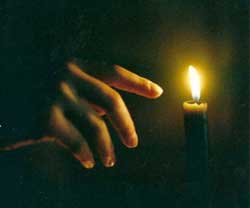
#680: “haptomai; reflex of #681; prop. to attach oneself to, i.e. to touch (in many implied relations): – touch.

#681: “hapto; a prime verb; prop to fasten to i.e. (spec.) to set on fire: – kindle, light.

Paul uses this word to introduce his views on marriage, and concludes, “…it’s better to marry than burn…” 1 Corinthians 7:9.

What seems to be in view here is a particular kind of a touch, that puts one in conflict with the Kingdom or government of God.

Jesus seems to be using the word “touch” in the same way as he goes onto explain what he needs to do next, as contrasted with the rather immediate influence of Mary touching Him, “…I am not yet ascended to my Father: but go to my brethren, and say unto them, I ascend unto my Father, and your Father; and to my God, and your God.”

In short, the next thing on Jesus’ Kingdom agenda is to ascend to His Father.
In context, it is safe to say that in that moment ascending to His Father was His Father’s will for Him, and He knew it.

From Paul’s perspective we would have to say that where this kind of a touch is concerned, we need to be understand it in context. There are circumstances, where touching, even in this sense is  “…the better part.”  Paul explains that married couples should not deprive each other in this sense, 1 Corinthians 7:5.

That should be clear enough on its face, so then to look a little deeper into this we need to go back to what Jesus said to Mary at the grave site:

“Touch me not…” Restating this according to the meaning of the prime verb, it becomes, “Do not fasten on to me so as to set me on fire…”

While it’s possible that Jesus was concerned that Mary not be set on fire, His explanation seems to suggest that they would be “fastened” together in the flame. As for His part, His priority in the moment was to go to His Father.

This is not to imply that He was talking about the chemistry of the flesh, but rather that there was a spiritual conflict of interest in the moment. She being less spiritual than He, it was His leading of the Spirit that had to govern the conversation and the body language. It would not be long before they would be together again, but that would be a matter of the Spirit.

On the day of Pentecost, He came back to actually live in her by the Spirit. (Of course, this assumes that Mary was there that day in the upper room when the Spirit came in tongues of fire.)

What I am saying here is that there is a “touch” which can alter the content of the mind, changing it to do something other or less than God’s will. Not only is this possible where physical chemistry is concerned, but where the chemistry of the Spirit is concerned as well.

The church at Ephesus was rebuked for “leaving their first love,” for “forgetting the height from which they had fallen.” This is to say, that there is a sense in which we are to be “set on fire,” a sense in which we should be “fastened,” and it includes, in fact consists of the chemistry of The Spirit.

In the present moment I am mindful of something that the “disciple that Jesus loved” wrote in this connection:

“That which was from the beginning, which we have heard, which we have seen with our eyes, which we have looked at and our hands have touched—this we proclaim concerning the Word of life.” 1 John 1:1

It was for John, the disciple who leaned his head on Jesus’ chest at the Last Supper to make such a proclamation, one that included the fellowship of touching.

Some time ago now I had a rather masculine word picture of what happens as the result of chemical or even spiritual touch. It had to do with a reverse acting solenoid.

Commonly solenoids are operated by an electric current, which opens and closes a valve, permitting or restricting the flow of a fluid. Where this kind of “touch” is concerned, it is the fluid, which actuates the flow of electrical current, in this case to the brain, and affecting the content of the intellect. The result is that the intellect thinks differently, and comes to different conclusions, and even different priorities.

The priority of Jesus, for Instance was to go to His Father. Mary’s touch seemingly had the power to alter that priority, so it was better or, as Paul might say, “Good for her not to touch Him.”

Understanding this we can see that this kind of a touch, or the influence that it has, is different than the influence anticipated by “greeting one another with a holy kiss.” That said, it’s very important for the kissers to know what they are doing, and be in possession of godly honesty. If we can’t greet one another in that way without being set on fire with ungodly passions, then, “… it is good for a man not to touch a woman.” We need also to understand that there is a touch that “fastens” and “sets on fire” that is good and godly and desirable for the maintenance of the Spirit’s fire in the community of faith.

In my next post, I hope to talk about this kind of touch from a spiritual perspective.

Love!

  • By Jay Ferris, originally posted November 2012
Posted in J.Ferris: Reposts with Notes | Leave a comment

How Little We Know

How Little We Know by Jay FerrisIn a recent weekly conversation focused on the book of Revelation, we enjoyed a number of interesting and diverse perspectives on this rather timely Book. One way or another the world as we have known it seems to be coming to an end.

Our little conversation included believers from a diversity of backgrounds, and that always guarantees a number of popular positions on the meaning of this fascinating Letter. Included in this diversity was a very nice range of ages. And it is this diversity of age that I want to share about here.

By the time we reached Chapter 21, we had quite a struggle between a literal interpretation, (there are a number of those even among the older saints) and a more symbolic interpretation.

Being in many respects a symbolic, even parabolic kind of a guy, I probed to see why it was so difficult for a young woman to get the symbolism in the Letter, and this chapter in particular. Finally, it occurred to me to ask her if she had ever been in love. As I did, the song (which this post is titled after) came immediately to mind, though I hadn’t heard it for many years. At 74, I had to go look up the lyrics:

How little we know
How much to discover
What chemical forces flow
From lover to lover

How little we understand – what touches of that tingle
That sudden explosion – when two tingles intermingle

Who cares to define
What chemistry this is
Who cares with your lips on mine
How ignorant bliss is

So long as you kiss me – (and) the world around us shatters
How little it matters – how little we know

The song was even a better elaboration on the problem we were having than I had remembered. She admitted that she had never been in love.

If you have never been in love, there are some things that are very hard, really impossible to understand.

The problem gets even more difficult when we have been exposed to a lot of religion. But when we peel back all the teachings of men, and look full on into the Bible with our eyes and ears open, (it helps to have our hearts open as well) we find that there is a lot of Bible that is very difficult to understand if we have never been in love, even in the old creation sense.

There are no chemical forces in the old creation, for instance, that can hold a candle to the chemical forces of the Spirit of God. There is no kiss in the old creation that can compare to the kiss that begins Song of Solomon.

And where “the world around us shatters” is concerned, it would be difficult to surpass the message of the Book of Revelation. The eschaton certainly is the shattering of the world as we know it.

Perhaps it is enough to say that for many years the very rocks have been crying out in secular music and lyrics. What we need is to tune our ears and hearts to the Spirit, hearing the love of God extolled in unlikely places, even in the songs of this world.

Love!

P.S. In the past couple of days this blog has been upgraded to include media of various kinds, adding audio messages, songs, and this video interview. Most of the songs came from our stay in Connecticut, while enjoying a month off from my chemo-therapy. One of the things I have found doing karaoke is that I don’t feel any pain when I sing. As for the audience, you will have to be the judge of that. :-)

  • By Jay Ferris, originally published October 2012.
Posted in J.Ferris: Reposts with Notes | Leave a comment